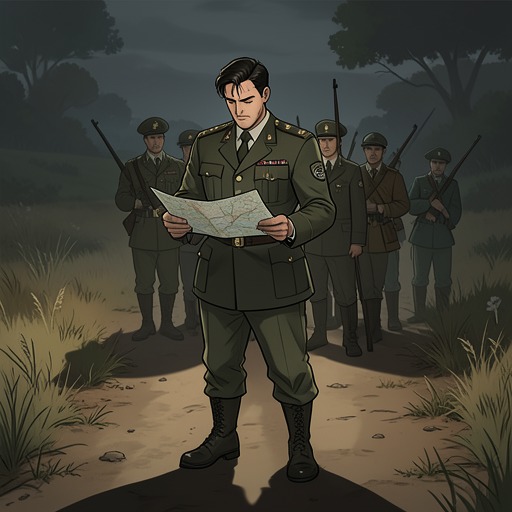
Fifth Railway Regiment
The Narrow Road to the Deep NorthThe Fifth Railway Regiment is the Imperial Japanese Army unit through which Tenji Nakamura enters the construction of the railway linking Siam and Burma. At first he regards the assignment as a historic national mission; on the ground, its grand design becomes a punishing engineering project dependent on prisoners of war and other coerced laborers. The railway’s eventual destruction exposes the distance between imperial ambition and the lives consumed in making it real.
Identity and Imperial Mission
As an officer of the Imperial Japanese Army’s Fifth Railway Regiment, Nakamura is assigned to a project the Japanese High Command has ordered built in the shortest time possible. Before the war, English and American investigators had judged a railway across this terrain impossible. Nakamura nevertheless takes pride in his role, imagining his life joined to a national and imperial destiny. The regiment’s work is thus introduced not simply as engineering, but as a practical expression of the belief that the Emperor’s will and Japanese spirit can overcome material limits.
The strategic urgency sharpens by 1943. Japan is overstretched and losing ground, while the Allies supply the Chinese Nationalist Army through Burma and American control of the seas constrains Japan’s options. The railway is intended to move men and matériel to Japanese forces in Burma, supporting both the effort to cut the supply route to China and the ambition to take India. Japan lacks the money, machinery, and time for ordinary construction; the project proceeds instead through a mixture of military command, improvised engineering, and forced labor.
Engineering Orders and Conditions
The route first appears as a straight line of surveyors’ pegs driven into the ground by Imperial Japanese Army engineers. It marks a projected railway of 415 kilometres, running from north of Bangkok through to Burma. When the Australian prisoners arrive in Siam in early 1943, they are given blunt axes and rotten hemp rope and ordered to fell, grub, and clear a kilometre of giant teak trees along the proposed route. The immense line begins as a plan marked on the landscape, but its first work is the physical removal of the jungle.
The gap between plans and available means recurs in the technical orders. Although a major cutting is already half complete, the Railway Command Group directs Nakamura to enlarge it by a third to address gradient problems in the next section. The revision requires another 3,000 cubic metres of rock to be cut and carried away. Prisoners work the rock by hand with hammers and chisels; Nakamura lacks proper chisels, and the forge has too little coke to sharpen the tools when they blunt. He says that drilling machines with compressors would help, but the project’s demands exceed the equipment on hand.
The wider conditions make the engineering burden more severe. The monsoon floods the river, making it too dangerous to bring heavy loads upriver, while the road is mostly impassable and supplies dwindle. There is no machinery, only poor hand tools; too few prisoners are available, and many of those still alive are in bad condition. Cholera has arrived as well. Nakamura responds to the growing solitude and distress of the work by throwing himself into it, but increased effort only deepens the impossible equation between the railway’s demands and the means provided to meet them.
Labor and Human Cost
The railway’s construction depends on coerced labor at a vast scale. Of the 22,000 Australian prisoners of war, most captured after the fall of Singapore, 9,000 are sent to work on the railway. Allied prisoners account for only part of the workforce: about 60,000 prisoners of war labor on the project alongside a quarter of a million or more Tamil, Chinese, Javanese, Malayan, Thai, and Burmese laborers. Estimates of deaths among these Asian laborers range from 50,000 to 200,000, and the total remains unknown.
On 25 October 1943, steam locomotive C 5631 travels the completed Death Railway with three carriages carrying Japanese and Thai dignitaries. Its passage is set against the human cost of the achievement: the line runs past countless graves, and the remains of one in three of the Australian prisoners sent to work on it lie among them. Completion therefore registers both as an engineering milestone and as the outcome of a system that converted an impossible schedule into bodily exhaustion and death.
Aftermath and Significance
With the defeat of the Japanese Empire, the railway loses its military purpose and support. Japanese engineers and guards responsible for it are imprisoned or repatriated, and the remaining enslaved laborers are freed. The Thais abandon the line, the English dismantle it, and tribespeople pull up and sell its rails. Its banks bend and break, embankments and bridges wash away, and cuttings fill in; vegetation returns among the remains of the dead and the tools used to build it.
The railway’s surviving fragments become tourist, sacred, and national sites, but the line itself is broken and its vast project comes to nothing. A plaque in front of C 5631 does not record the horror of construction, and no agreed count exists for all those who died. The Fifth Railway Regiment’s project consequently stands in the narrative as infrastructure made inseparable from imperial violence: a route imposed on the landscape by command, forced labor, and loss, then dismantled and absorbed by the natural world.